| 1st Week | Branches of Private Law |
| 2nd Week | Essentials of Contract Law |
| 3rd Week | Formation of a Binding Contract |
| 4th Week | Remedies of the Parties |
| 5th Week | Property Rights and Property Law |
| 6th Week | Principles of Property Law |
| 7th Week | Creation, Transfer, and Termination of Property Rights |
| 8th Week | Principles of Tort Law |
| 9th Week | Mechanisms for the Distribution of Damage |
| 10th Week | Elements of Procedural Law |
| 11th Week | Some General Aspects of Procedures |
| 12th Week | Legal Reasoning |
| 13th Week | Interpretation |
| 14th Week | The Relationship Between Private Law and Human Rights |

This book is the first textbook written in English by a Turkish scholar at an introductory level to provide an up-to-date, thorough, and comprehensive overview of the theoretical principles and main legal concepts of Constitutional Law which forms the system of law in every country.
As an introductory work with special references to Turkish Constitutional law, this book also provides not only an introduction to the legal system of Turkey but also of the United States of America and of the Russian Federation. I believe that this approach is suited to the grovving numbers of foreign students at the faculties of law and the faculties of political sciences in Turkish universities which give greater importance to English textbooks even in law subjects.
Week 1 — Course Introduction and Foundations: The Road to the Modern State
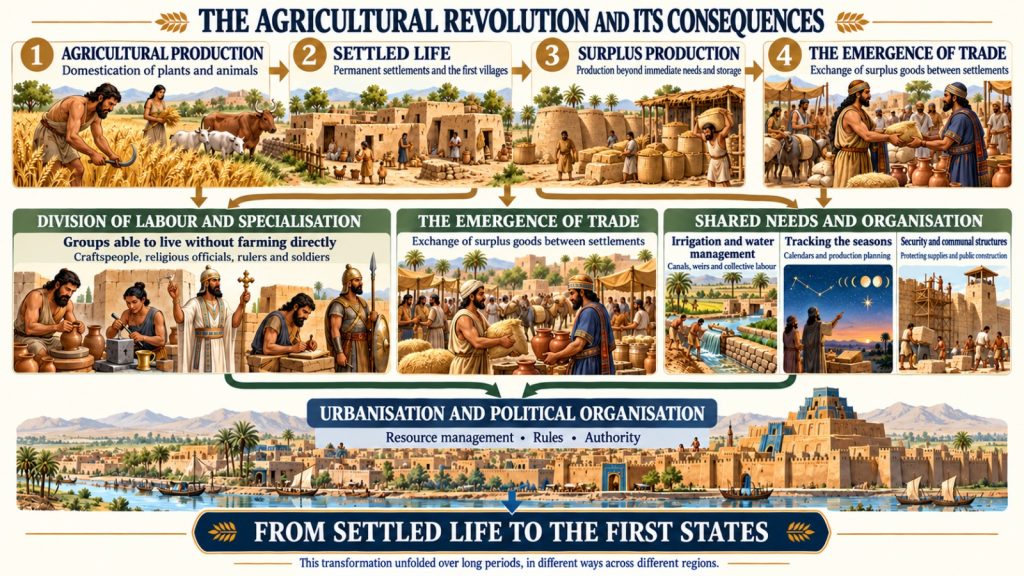
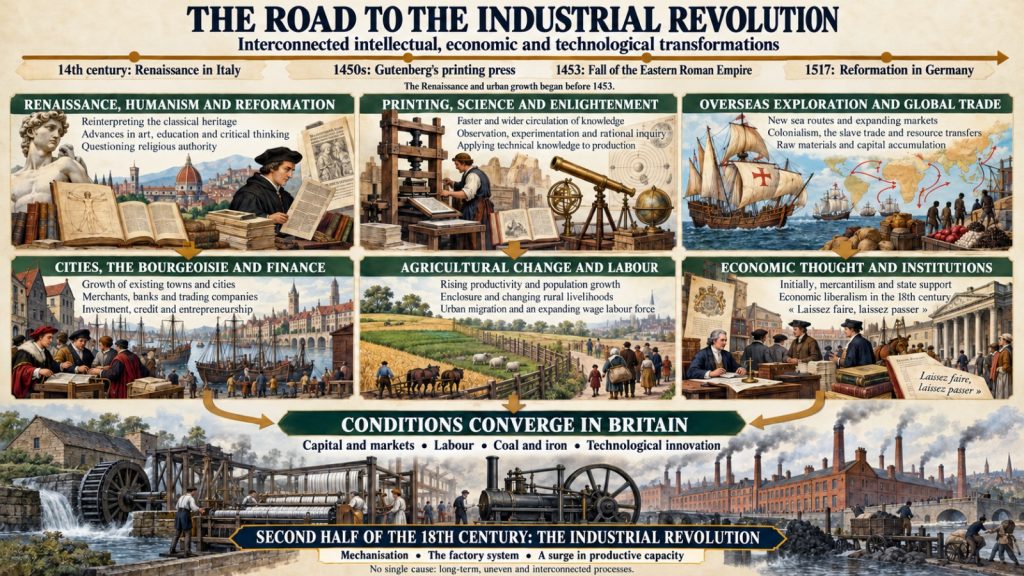
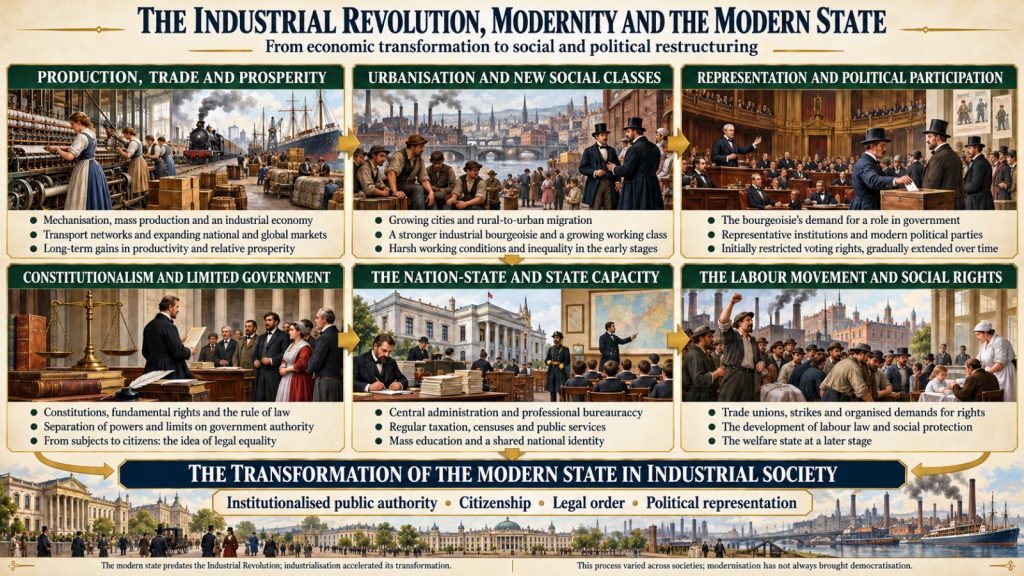
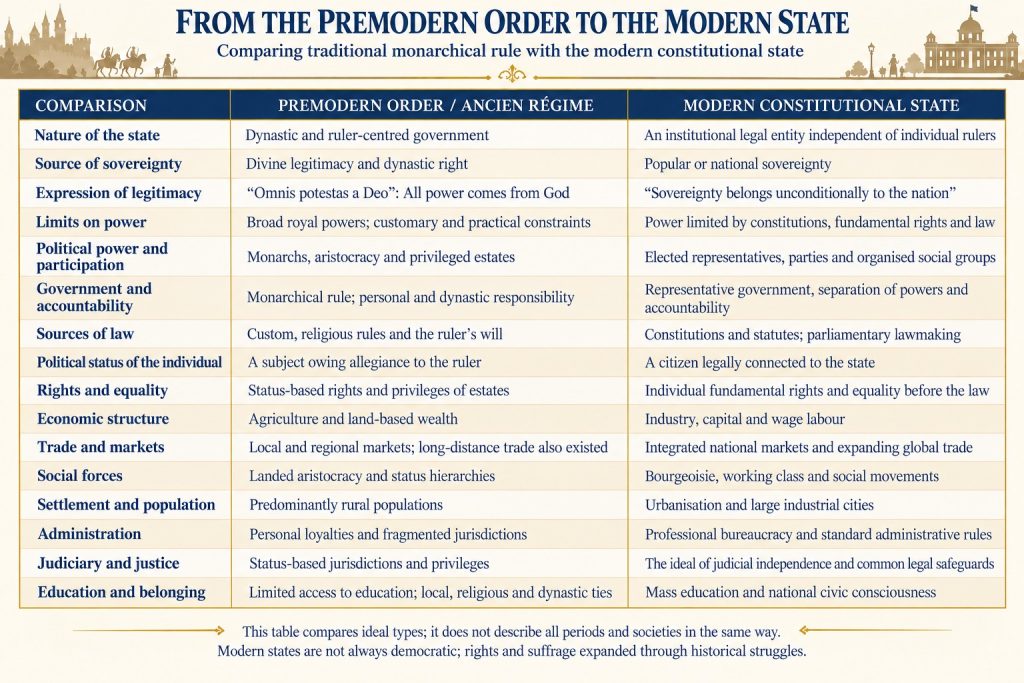
The first week introduces the course aims, scope, teaching approach and materials. It then explores the historical transformation from the Agricultural Revolution to the emergence of the modern state. Topics include the impact of agricultural production and settled life on political organisation; the intellectual, economic and social developments leading to the Industrial Revolution; and the relationship between industrialisation and the modern state. The premodern order and modernity will be compared, particularly in terms of sovereignty, limits on power and the political status of the individual.
Visuals and Topic Outline
- The Agricultural Revolution and Its Consequences
- The Road to the Industrial Revolution
- The Industrial Revolution, Modernity and the Modern State
- From the Premodern Order to the Modern State
Discussion Questions
- How did the Agricultural Revolution transform collective needs and the organisation of government?
- What intellectual, economic and social conditions paved the way for the Industrial Revolution?
- How is the emergence of the modern state related to industrialisation?
- How can we explain changes in the source of sovereignty, the legitimacy of government and the transition from subjecthood to citizenship with the rise of modernity?
Week 2 — The American Constitutional Revolution, Separation of Powers and the Hierarchy of Norms
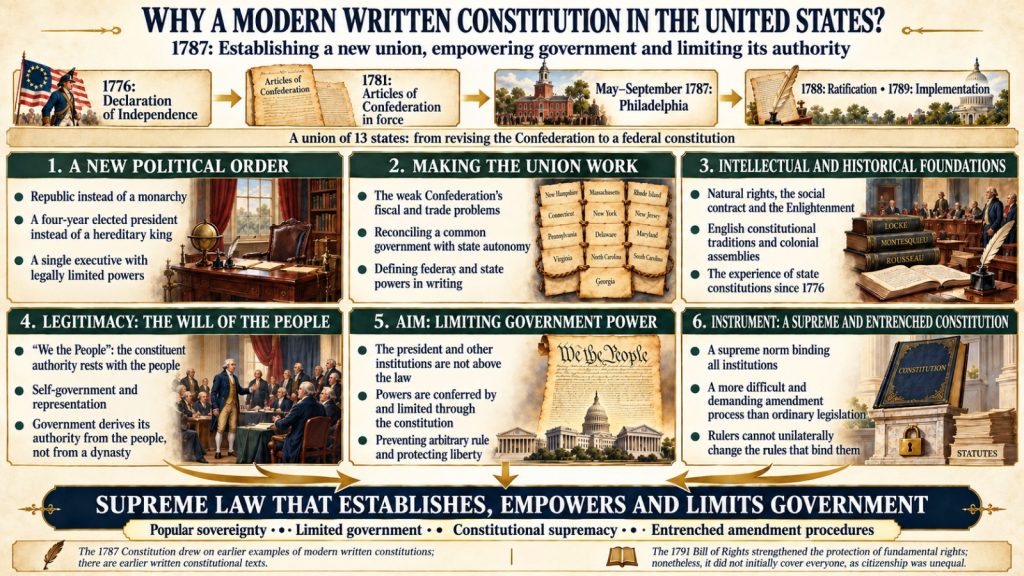
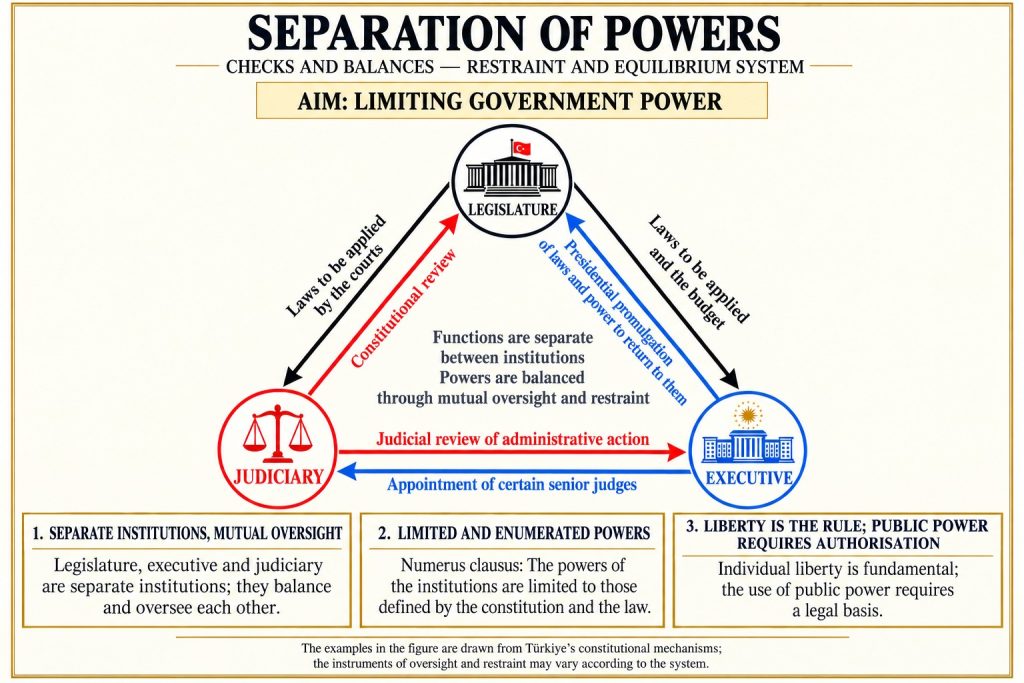
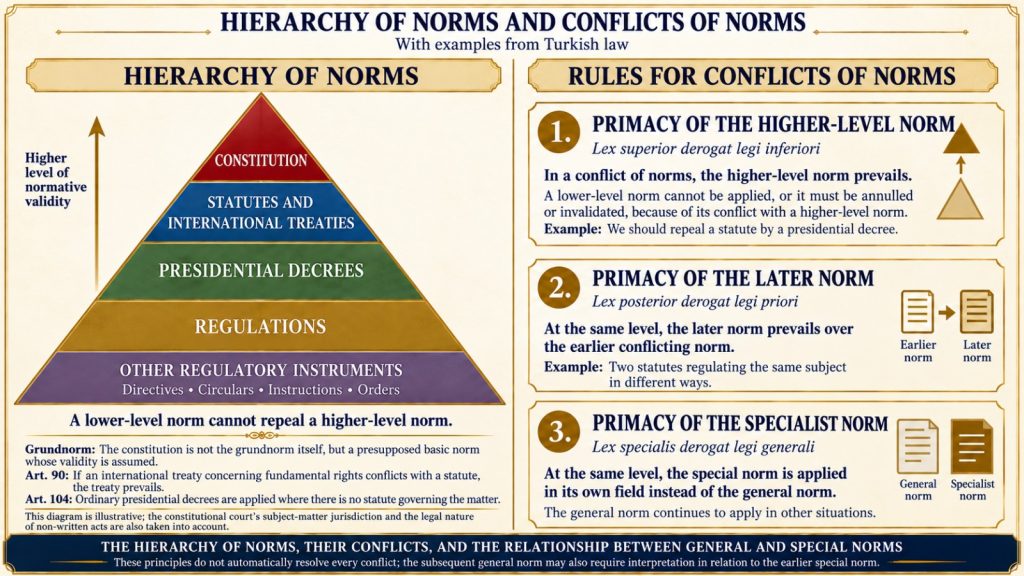
The second week examines the circumstances surrounding the adoption of the 1787 US Constitution and its pioneering role in modern written constitutionalism. It explores the relationship between establishing a new political order and limiting government power through supreme and binding rules. The purpose of the separation of powers and its implementation through checks and balances in the American constitutional system will be discussed. The hierarchy of norms and the basic principles used to resolve conflicts between legal rules will then be explained.
Course Visuals and Topic Outline
- Why a Modern Written Constitution in the United States?
- Separation of Powers and Checks and Balances
- The Hierarchy of Norms and Conflicts of Norms
Discussion Questions
- Why did establishing a new political order in the United States create a need for a supreme, binding constitution that would be difficult to amend?
- What does the separation of powers mean, and how are mutual oversight and balance achieved in the American constitutional system?
- What is the hierarchy of norms, and what does constitutional supremacy mean?
Week 3 — The Nature, Structure and Types of Constitutions
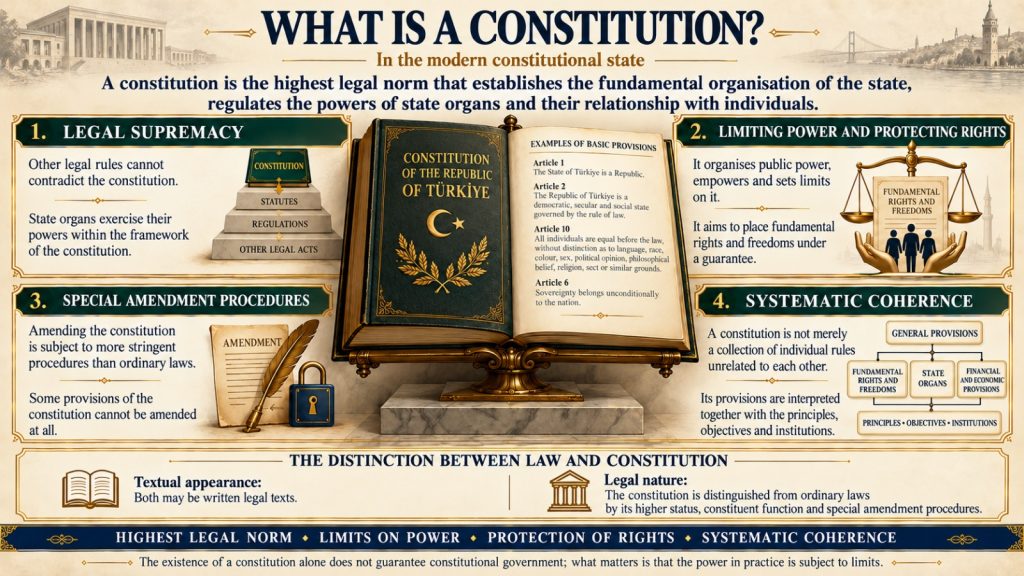
Having explored the historical emergence of constitutions during the first two weeks, this week examines the constitution as a legal norm. Beginning with the question “What kind of text is a constitution?”, the discussion addresses its definition, legal nature and systematic structure. The features distinguishing constitutions from statutes, their principal contents and their classification according to different criteria will be examined.
Course Visuals and Topic Outline
- What Is a Constitution?
- The Structure of Constitutions
- Differences Between a Constitution and a Statute
- The Contents of Constitutions
- Classifying Constitutions
Discussion Questions
- What kind of legal norm is a constitution, and what do its supremacy and constituent function mean?
- How do constitutional provisions form a coherent whole?
- How do constitutions differ from statutes in normative status, adoption, amendment and content?
- What principal subjects do constitutions regulate?
- What criteria are used to classify constitutions, and what do these classifications reveal?
Week 4 — Constitution-Making and Constitutional Amendment
This week examines the circumstances, actors and methods involved in making and amending constitutions around the world. Drawing on waves of constitutionalism, it explores the historical and political developments that create a need for new constitutions. Forms of public participation, procedures for amending existing constitutions and the role of constituent power will be explained. Particular emphasis will be placed on distinguishing the establishment of a new constitutional order from amendment within an existing order.
Course Visuals and Topic Outline
- Waves of Constitutionalism
- When Is a Constitution Made?
- Methods of Constitution-Making
- Constitutional Amendment
- Original and Derived Constituent Power
Discussion Questions
- What historical and political circumstances trigger constitution-making?
- At which stages and through which methods can the public participate in constitution-making?
- How does making a new constitution differ from amending an existing one?
- Why are constitutional amendments subject to special procedures and broad consensus?
- How do original and derived constituent power differ in their sources, functions and limits?
Week 5 — The Three Dimensions, Interpretation and Implementation of Constitutions
This week examines the constitution through its interconnected legal, political and social dimensions. Five methods of constitutional interpretation and the principal interpretive guidelines will be explained. Attention will then turn to the relationship between constitutional texts and political reality. Recognising that the rules discussed in class are not always reflected in practice, the discussion will explore how constitutional safeguards can be undermined through sham constitutions, façade constitutions, deconstitutionalisation and abusive constitutionalism.
Course Visuals and Topic Outline
- The Three Dimensions of a Constitution: Law, Politics and Society
- Constitutional Interpretation
- The Constitution in Practice
Discussion Questions
- How do the legal, political and social dimensions of a constitution influence one another?
- How are textual, systematic, historical, purposive and logical methods of interpretation used?
- How do interpretive principles contribute to limiting power and protecting rights?
- Is the existence of a constitution sufficient to establish a constitutional state?
- How are constitutional safeguards eroded in practice, and how do deconstitutionalisation and abusive constitutionalism arise?
Week 6 — The Elements, Structure and Different Conceptions of the State
This week introduces the definition of the state and its constituent elements: territory, population and sovereignty. Unitary and federal structures will be compared, and the allocation of powers between federal institutions and constituent units will be examined. Regional states, confederations and community-based federalism will also be explained. The distinction between monarchy and republic will then be considered in terms of how the headship of state is acquired. Finally, states will be classified according to their relationship with religion, their subjection to law, their economic organisation and the responsibilities they assume.
Course Visuals and Topic Outline
- The State: Definition and Elements
- State Structure: Unitary and Federal States
- How Does a Federal State Work?
- Regional States, Confederations and Community-Based Federalism
- Monarchy and Republic
- Classifying Conceptions of the State
Discussion Questions
- What are the constituent elements of the state, and what do internal and external sovereignty mean?
- How do unitary and federal states differ, and how are powers distributed within federations?
- What distinguishes regional states, confederations and community-based federalism?
- Why is the monarchy–republic distinction different from the democracy–authoritarianism distinction?
- What different criteria underlie the concepts of secular, theocratic, liberal, socialist, welfare and rule-of-law states?
Week 7 — The Basic Functions of the State: Legislature, Executive and Judiciary
This week examines the legislative, executive and judicial functions of the state, together with the structures, responsibilities and relationships of the institutions performing them. Following an examination of parliamentary functions and safeguards, the discussion turns to executive structures and functions. Judicial independence, impartiality and their principal safeguards will also be addressed. These topics provide the conceptual foundation needed to understand and compare systems of government.
Course Visuals and Topic Outline
- The Three Basic Functions of the State
- The Legislature: Structure and Functions
- Parliamentary Safeguards: Non-Liability and Inviolability
- The Executive: Structure and Functions
- The Judiciary: Function, Safeguards and Organisation
Discussion Questions
- How do legislative, executive and judicial functions differ, and what is the distinction between an institution and its function?
- What responsibilities do parliaments perform beyond lawmaking?
- Why are parliamentary non-liability and inviolability necessary, and what are their scope and limits?
- How do different executive structures affect decision-making and government?
- What safeguards support judicial independence and impartiality?
- How do the selection, mutual powers and accountability of the legislature and executive shape systems of government?