| 1st Week | Scope, resources and method of the course |
| 2nd Week | Historical development of the criminal justice system |
| 3rd Week | The construction of the modern criminal justice system |
| 4th Week | Contemporary criminal justice systems |
| 5th Week | Elements of crime |
| 6th Week | Fundamental principles of substantive criminal law |
| 7th Week | Fundamental principles of criminal procedure law |
| 8th Week | Investigation phase and Rights of the suspect |
| 9th Week | Law enforcement agencies |
| 10th Week | Court organization and trial process |
| 11th Week | Judicial reasoning and criminal adjudication |
| 12th Week | Witness testimony and expert evidence |
| 13th Week | Prisons and the correctional system |
| 14th Week | Alternative sanctions and prohibitions |
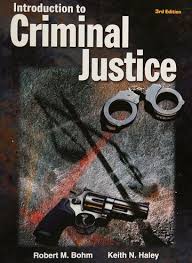
Robert M. Bohm’s Introduction to Criminal Justice (2002) is a comprehensive introductory textbook on the criminal justice system. Focusing primarily on the United States, the book examines the phenomenon of crime and the core components of the criminal justice system—law enforcement, courts, and corrections—within an integrated framework.
The main objective of the work is not only to describe institutional structures but also to analyze the social, political, and ethical dimensions of criminal justice. Bohm discusses major criminological theories explaining the causes of crime and explores the role of the state in crime control, highlighting the tension between public security and individual rights.
The book also provides clear and accessible explanations of policing practices, investigative procedures, judicial processes, and correctional systems. Designed as a teaching resource, it includes case examples, conceptual discussions, and pedagogical tools that make it widely used in introductory criminal justice courses.
Overall, the work stands out for presenting the criminal justice system not merely as a technical mechanism, but as a dynamic structure reflecting broader principles of social order and the rule of law.